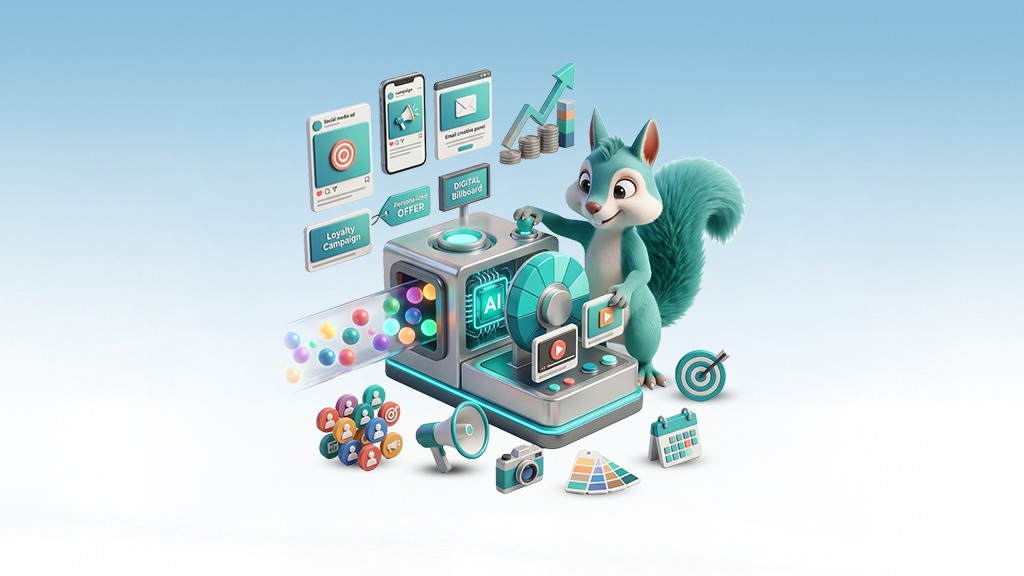
Marketing ROI is no longer a matter of a report you review after a campaign ends. For today’s marketing teams, the real difference lies in reading customer signals while a campaign is still running, redirecting budget at the right moment, and optimizing performance in real time with AI-powered decisions.
Because sustainable success in marketing doesn’t come from producing more campaigns, it comes from making faster, more accurate, and more connected decisions.
The old model: launch, wait, report
Most marketing teams still operate on a familiar cycle: the campaign is designed, creatives are prepared, the launch begins, a few days or weeks pass, and finally the performance report is reviewed.
This model worked in the past, yes. But today, customer behavior, channel performance, and budget efficiency change far more quickly. The report that arrives at the end of a campaign is still valuable. Yet if an underperforming channel has already burned through the budget, the insight you gain won’t bring that lost budget back.
That’s why the critical question for marketing is no longer: “What happened at the end of this campaign?”
The real question is: “While the campaign was running, which signal did we see, how quickly did we decide, and what action did we turn that decision into?”
The new model: ROI is managed through real-time decisions
There’s a big difference between reading data after a campaign ends and reading it while the campaign is still running. That difference is like the difference between looking at the score after the concert is over and conducting the orchestra live while on stage.
In the new marketing approach, optimization is no longer a reporting step, it becomes a natural part of the campaign itself.
Underperforming ad sets are spotted earlier. Budget is redirected to the channels producing better results. Segments are updated throughout the campaign. Signals from customer behavior determine what the next best action should be.
In the 2026 approach, this structure goes even further. AI is no longer just an assistant that runs analyses or produces content, it becomes a new operational layer where agents working on different tasks talk to one another, interpret customer data, and accelerate marketing actions.
While one agent monitors campaign performance, another can analyze shifts in the target audience. A third can check sales signals and recommend which lead should be prioritized. Yet another can reflect a customer satisfaction signal from service data back into the campaign flow. At this point, marketing automation stops being a system that merely sends emails. As a result, it turns into a real-time decision system where CRM, customer data, campaign performance, and AI agents all work together.
Why faster decisions, not more campaigns?
Because individual campaigns can deliver periodic success. But for sustainable marketing ROI, campaigns need to be part of a learning system rather than disconnected from one another.
This system has three core components:
1.Shared customer data
Customer behavior, channel performance, sales signals, service interactions, and campaign results must come together around a single customer view. It’s not possible to make fast decisions with scattered data. That’s why CRM and customer data management sit at the center of marketing performance.
2.The right decision moment
What determines ROI isn’t only which metric you track, but when you read that metric. There’s a serious budget difference between noticing that an ad set is underperforming three weeks later versus catching it on the second day.
3.A system that can act
Seeing the data isn’t enough on its own. The system needs to be able to redirect budget based on defined thresholds, update segments, carry meaningful signals to sales teams, or restructure the customer journey.
When these three structures come together, marketing teams become able to manage customer experience, performance, and growth within the same system and efficiency increases.
How do AI agents change marketing ROI?
The impact of AI agents in marketing isn’t just that they reduce manual work. The real value is that they increase decision speed and can build connections across different data sources.
According to Gartner’s 2026 forecast, a significant portion of enterprise applications will run with task-specific AI agents. For the marketing world, this means that campaign, CRM, sales, service, and customer experience systems will become increasingly agent-supported.
As a result, agents won’t just generate recommendations, they can also initiate actions within defined limits. For example, an agent can flag an underperforming target audience, suggest a new flow for a highly engaged segment, carry a hot-lead signal to the sales team, or provide decision support for budget optimization.
As a more advanced stage, the agent-to-agent operating model comes into play. When the marketing agent, the sales agent, and the service agent can communicate over the same customer data, the customer journey is managed more consistently and more quickly. In this way, marketing ROI is fed not only by ad performance, but by the joint optimization of the entire customer experience.
What does Salesforce’s current approach tell us?
Salesforce’s current approach supports this transformation as well: customer data, CRM, marketing automation, and AI agents are now considered within a single customer experience architecture.
The Agentforce 360 approach that stood out at Dreamforce 2025, positioning structures like Data 360, Customer 360, and Slack together with agentic AI, aims to help companies build more contextual, controlled, and consistent AI interactions across their customer and employee experiences. From a marketing perspective, this points to a model in which campaign data no longer moves in isolation from sales and service signals, and the customer journey is managed through a more integrated data and action layer.
In this approach, marketing is not merely a function that sends campaigns. It is a growth system that reads customer data, takes sales and service signals into account, updates the customer journey in real time, and produces action.
In other words, the real value of AI in marketing emerges not only in content production, but in turning customer data into action — and action into measurable business results.
The Inspark perspective: ROI is a matter of structure
As Inspark, we approach marketing ROI not merely through campaign performance, but as an end-to-end system. In line with the Salesforce Marketing Cloud Next approach, we place importance on having customer data, segmentation, personalization, marketing automation, and AI-powered actions all work within the same structure.
Because in our view, sustainable ROI comes from building a system that can read the right customer signal at the right moment and turn it into action. When CRM, customer data, and marketing automation are set up correctly, campaigns don’t just create visibility, they turn into measurable business results and growth.
ROI isn’t a formula, it’s a matter of structure. When the right metric, the right moment, and the right authority to act come together, marketing turns into a growth system that learns from campaign-based results and continuously optimizes itself.
You, too, can get in touch with us to move your marketing investments toward a more measurable, more agile, and AI-powered structure, and to manage CRM, customer data, and marketing automation in a more integrated way. To learn more about Salesforce’s agentic AI approach, you can explore the Salesforce Agentforce page.