Today, the traditional understanding of CRM is undergoing a fundamental transformation. As we often emphasize at Inspark, CRM is no longer just a data repository. It has become an operational center that provides agentic AI systems with organizational memory, strategic logic, and a secure governance framework.
In enterprise settings, Large Language Models (LLMs) may look flawless on paper, but without organizational discipline, they can easily turn into “an inconsistent colleague.” What truly creates business value is binding these models to structured workflows and meaningful data. Yes, LLMs are impressive. They enable rich interactions, improvise, mimic creativity, and answer complex questions in seconds. However, on their own, AI systems are still not capable of running enterprise processes reliably.
There is a critical point to underline here. An LLM can generate a highly convincing answer, but it cannot verify whether that answer complies with your company policies or whether it passes data privacy controls correctly. This is why the phenomenon known as “jagged intelligence” can cause AI systems to make fundamental reasoning errors, even momentarily.
Consider a risky scenario. A healthcare assistant responds to a billing inquiry but accidentally discloses a patient’s confidential medical history. This is exactly where CRM becomes essential. In such cases, you need clearly defined rules, structured processes, and grounded data. Without CRM, next-generation AI does not operate on certainty. At best, it guesses. At worst, it hallucinates.
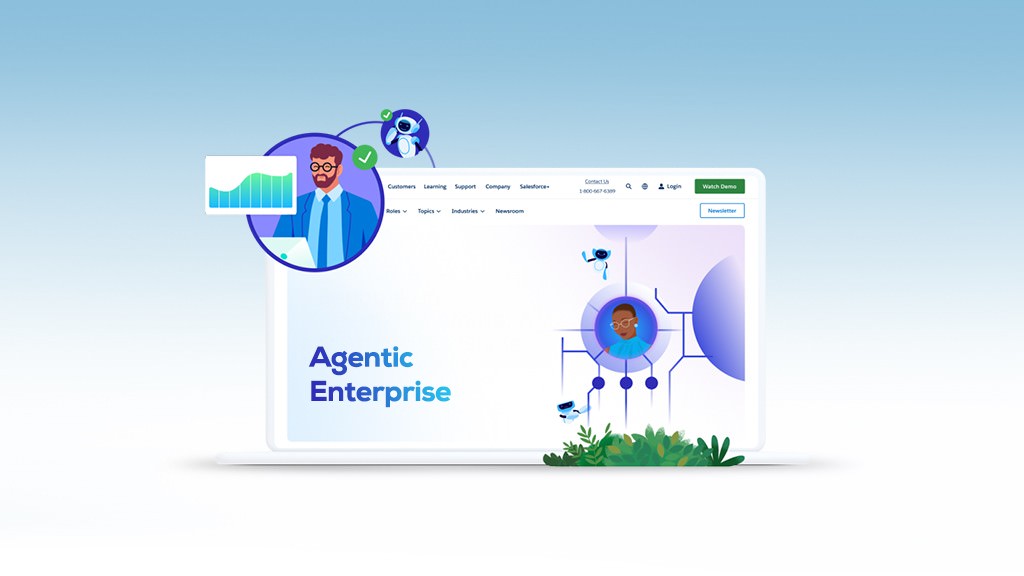
AI Needs Rules
CRM Defines and Governs Them
Let’s be clear. Unlike CRM systems, LLMs are black boxes. Although they are often described as “intelligent,” at their core they are pattern-matching machines that do not truly know anything. Without assistance, they cannot remember what happened five minutes ago. They cannot consistently enforce business rules. They cannot recognize when they violate company policies. They cannot connect to your real-time data, tasks, or workflows. They cannot control data access permissions such as row-level security. They do not know when a human needs to step in.
This is why agentic AI, while sounding futuristic, is already an everyday reality within the Salesforce ecosystem. The agentic AI phase represents a stage where LLMs are equipped with tools, memory, and coordination capabilities. At this level, they can schedule meetings, generate summaries, and draft emails on demand.
However, for AI to become a truly “reliable colleague,” the following CRM foundations must be in place:
Metadata and Identity Ensures that every action is securely associated with the correct customer and employee.
Channel Integration Enables agents to deliver seamless experiences across Slack, WhatsApp, email, and other channels.
Human-in-the-Loop Allows AI to hand over work to a human at the right moment while preserving full context.
The Inspark Perspective: Human–Agent Collaboration
The real value is not in what agents can do on their own, but in how work flows between AI and humans. This is where Inspark stands out. With a trusted CRM foundation, Data Cloud that activates data, Tableau that turns insights into decisions, Slack as a collaboration layer, and Agentforce that transforms AI from words into reliable action, Inspark acts as a strong guide for this new era.
Would you like to move your organization toward a data-driven, AI-powered future? Get in touch with Inspark experts to explore Salesforce’s Agentforce vision and design use cases tailored to your business.