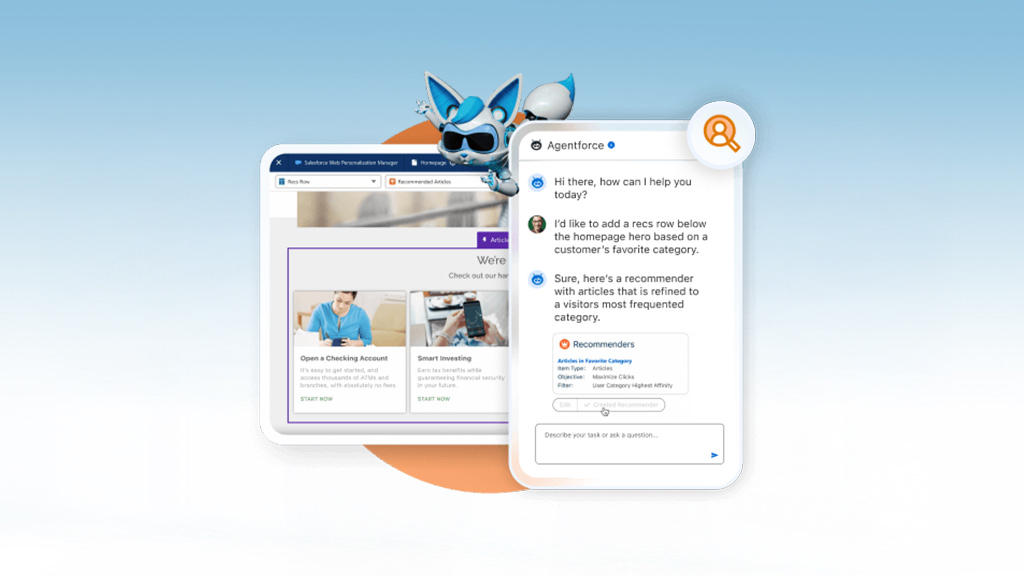
In the marketing world, we encounter a “revolution” every few years. However, this time, the change is not just a new feature or a fancy interface update. With Salesforce’s Agentforce Marketing move, the campaign-based working model we’ve been accustomed to for years is giving way to an AI-first orchestration logic.
So, what does this shift mean for the teams on the ground? Let’s examine how marketing is evolving from an operational burden into a strategic intelligence.
Salesforce’s New Approach: Agentforce Marketing
What Salesforce has achieved with Agentforce Marketing is more than just a rebrand, the underlying logic is fundamentally different. In this framework, Marketing Cloud is positioned as an orchestration layer that “reads,” decides, and executes. This structure has three core components:
- Real-time Intervention: The system reacts instantly when customer behavior changes. We are talking about seconds, not minutes or hours.
- The Right Decision at the Right Moment: AI determines which customer should receive what message, on which channel, and at what time. Furthermore, with Agentforce, this decision cycle operates autonomously.
- Omni-channel Orchestration: Email, mobile, web, advertising, and sales calls—in short, all channels—are managed through a single reasoning layer.
In this setup, AI is not just a consultant. Once the system reaches a certain level of maturity, it initiates actions in defined scenarios without waiting for human approval. This represents a significant breaking point in traditional marketing logic.
How Does This Transformation Affect Companies?
With this operating principle, marketing ceases to be a mere toolkit and transforms into an operational layer that shapes customer decisions. Naturally, this transformation is felt tangibly at every level of the organization.
For Marketing Teams: The manual workload is significantly reduced. Creating segments, deciding on channels, and timing messages are largely managed by the system. Teams can redirect this saved time toward strategy, customer insights, and creative processes. Moreover, go-to-market speed increases, as campaign launch cycles that used to take weeks are replaced by much shorter loops.
For Implementation Teams: Data is unified within a single structure, reducing integration complexity. In short, when the data model is correctly architected and events are properly managed, segments and decisions can be designed to function in real-time.
For the Enterprise: For this structure to truly work, three elements are vital: data maturity, integration infrastructure, and process alignment. For a company with “dirty” data, disconnected systems, or internal processes that haven’t adapted to the new model, Agentforce will remain nothing more than a product name.
The Human Factor: The concept of “fully autonomous” looks powerful in theory. In practice, however, human oversight and guidance still play a critical role. No matter how automated the system’s decisions become, defining the framework, setting the boundaries, and determining strategic priorities remains a human responsibility.
The Inspark Perspective
The value delivered by Agentforce Marketing requires a structurally sound foundation. Therefore, our goal is not just to “install” Marketing Cloud, but to re-engineer your entire marketing operation.
As Inspark, our approach is shaped exactly at this intersection. Beyond platform implementation, we support our clients in restructuring their organizations to fit this new marketing operation model. Because the technology is ready! You just need to get in touch with the operation team that will make it run.