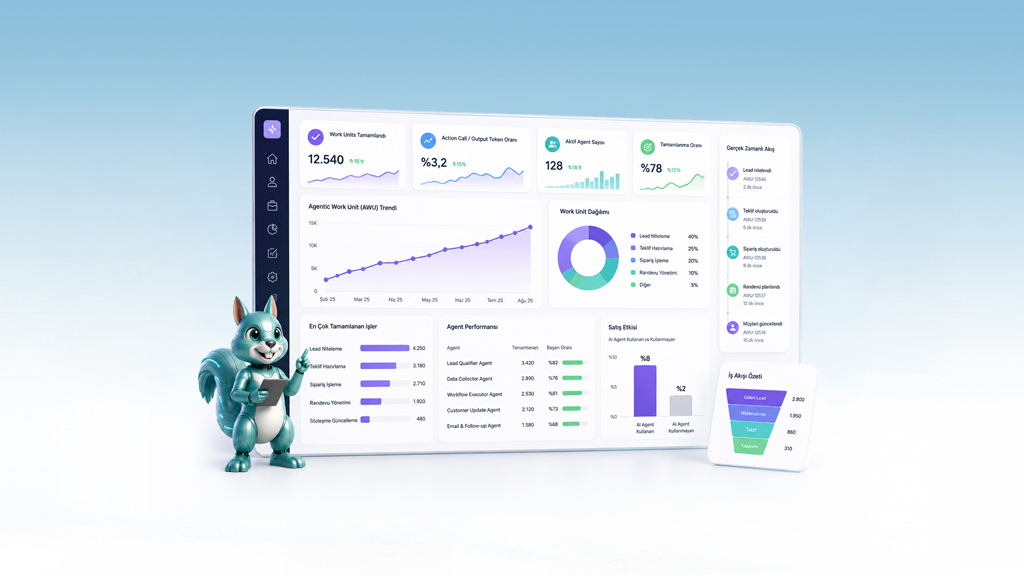
For a while, sales teams expected “a good answer” from AI: a decent email draft, an accurate customer summary, a smart recommendation. Today that expectation is shifting. Instead of “what did the agent say,” what matters now is directly “what work did it finish.”
This isn’t just a shift in language. Because success in sales automation is no longer sought in the quality of the text produced, but in the number of completed actions and the impact they create. The data clearly proves this shift.
The data shows this clearly
Salesforce’s Agentic Enterprise Index 2025-2026 report, published on August 7th, lays out this transformation in numbers. The report analyzes data from businesses that have been regularly using agents between February 2025 and April 2026, and highlights two key metrics.
The first is the concept they call “Agentic Work Unit” (AWU): a single concrete unit of work completed by an agent. The second is the ratio of agents’ “action calls” (calls that trigger a real-world transaction) to text generation (output tokens). According to the report, this ratio is growing 15% month-over-month on a compound basis. Salesforce sums this up with the headline “Agents Talk Less, Do More”: agents now talk less and produce more work.
This isn’t just a technical detail on its own. It’s also a critical signal about which criteria agent investments should be evaluated by.
From the AI assistant era to the execution-driven agent era
In the first phase, what was expected from an AI tool was this: producing a good answer, preparing a draft, extracting a summary, offering a suggestion. Decision-making and action always stayed with the human; the agent only provided input.
In the new model, the picture is different. The agent now checks the CRM record, applies the relevant business rule, triggers the correct workflow, processes the necessary updates into the system, and can initiate the next step of the process on its own. An example from the report makes this clearer: a service agent no longer just prepares a response draft regarding a customer’s order. It also accesses the relevant record, applies the rules, and personally finalizes transactions like returns or appointment changes.
On the sales side, this distinction is quite decisive. There’s a chasm between an agent telling a sales rep “you should contact this lead” and the agent thoroughly researching the lead, compiling the full CRM context, managing the qualification process end-to-end, activating triggered actions, and recording the final outcome in the system. The first is a suggestion, the second becomes a completed piece of work.
The Siemens example: agents dividing labor together
The Siemens example in the report makes this shift concrete. At Siemens, across seven different business units, 18,000 sales reps were accumulating 2,800 unqualified inbound leads per week. Sales teams couldn’t determine which lead to prioritize without budget, authority, and timing information. With Agentforce, however, this process was turned into a coordinated, multi-agent workflow: one agent contacts and nurtures the lead, while a second agent gathers missing data, applies qualification rules, and routes the lead to the right unit with the right context.
The critical point here, of course, is that the agents aren’t just generating information, they’re doing real work in parallel and in a coordinated way across different stages of the process.
The result shows up in sales too
The report’s most concrete finding on the sales side relates to the holiday season. Retailers using AI agents saw annual sales growth of 8%, while those not using agents stayed at 2%. In other words, agent users achieved a growth rate 4 times higher. This gap shows that agents are no longer just “a helper tool,” but have become a strategic layer directly impacting business outcomes.
The real question: what should we measure the agent by?
The question that emerges from this is clear: should we measure an AI agent’s success by the answers it produces, or by the work it completes?
Answer quality still matters, but it’s no longer a sufficient metric on its own. When evaluating agent investments, companies have to move from the question “how many agents do we have” to “which processes do our agents complete end-to-end.” Simply increasing the number of agents doesn’t create value on its own.
For an agent to genuinely be able to take action, that is, to go beyond making a suggestion and actually finish the job, it needs secure and consistent access to several things:
- accurate CRM data,
- clearly defined business logic,
- working workflows,
- and an orchestration layer that can seamlessly bridge the company’s different systems.
When any one of these elements is missing, the agent remains a “good talker”” but not a “job finisher,” still just an assistant. So the issue is, to a large extent, less about technical agent design and more about infrastructure maturity. Is the data integrity solid? Are the processes clearly defined? Are the systems genuinely connected to each other? When an agent is built on this foundation, it can move from producing answers to completing work.
Inspark’s Perspective
As Inspark, from the moment we set up agent projects, we approach it not with the question “how many agents do we have” but directly with “which process does this agent complete end-to-end.” Because our field experience shows us this: a poorly configured agent remains a layer that responds quickly but finishes nothing. The real difference emerges in how securely and consistently the agent can connect to CRM data, business rules, and internal company systems. That’s a matter of infrastructure and data discipline more than technology choice.
If you too want your agents to go beyond suggestions and take real action in your sales processes, you may first need to have your current CRM and data infrastructure assessed for readiness. If you’d like to work through this assessment together and design the right workflows and orchestration layer, we’d be glad to have you get in touch with Inspark’s expert team.