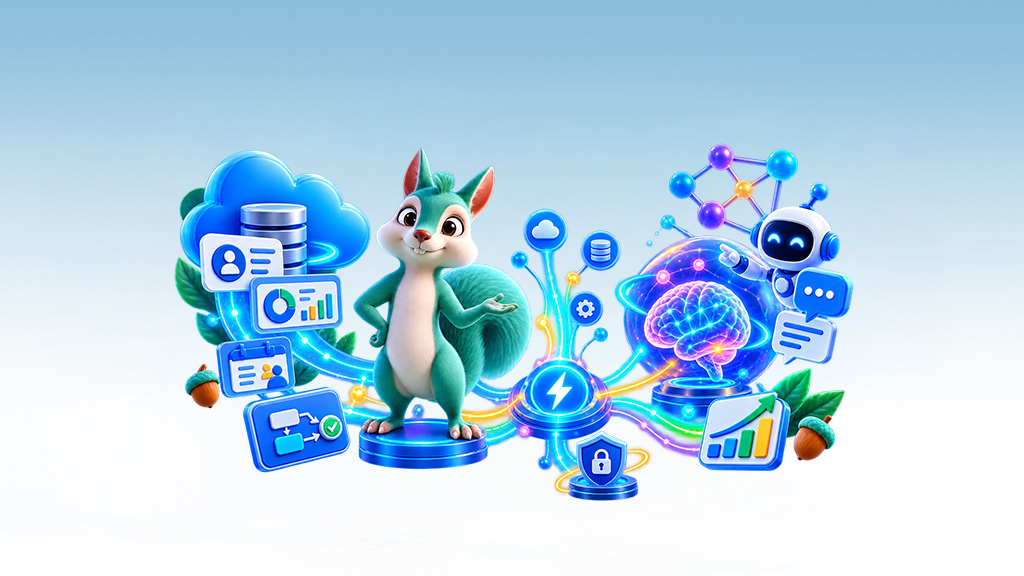
Salesforce and Anthropic, the developer of Claude, have signed a new strategic collaboration that could change how enterprise AI is used: Claudeforce.
Announced on August 26, 2026, Claudeforce brings together Claude’s advanced AI and reasoning capabilities with Salesforce’s enterprise data, workflows, business rules, actions, and governance infrastructure. However, what makes this collaboration significant isn’t just the integration of two powerful technology platforms. The real shift is AI moving from merely reading and interpreting enterprise data to becoming part of actual business processes in a secure and authorized way.
In other words, Claudeforce is preparing to reverse the working model where users constantly have to go to different enterprise applications:
Instead of the user going to the system, the system’s capabilities come to where the user and AI agents are working.
Check out Salesforce’s official Claudeforce announcement.
What Is Claudeforce?
Claudeforce is the name of the expanded strategic collaboration between Salesforce and Anthropic.
The collaboration brings together Claude’s advanced reasoning capacity with Salesforce’s trusted enterprise data, workflow, business logic, action, and governance layers.
The first concrete product is Salesforce in Claude.
Salesforce in Claude initially comes with 37 ready-made sales skills. Through these capabilities, users can analyze live Salesforce data from within Claude, automate pipeline updates, and directly perform actions authorized by the organization.
Tasks like meeting preparation, deal health review, and pipeline review are among these skills.
However, what makes Claudeforce significant isn’t what these features do individually.
It’s that Salesforce is starting to transform from being merely an application users log into, into a secure enterprise capability layer that AI agents can also use.
What’s Changing in Enterprise AI?
Until now, enterprise software has largely been designed around screens, menus, and applications. Users had to open the right application, find the right record, interpret the data, and then carry out the necessary action. With agentic AI, this approach is changing.
In the new model, the user says in natural language what they want to do, AI can then advance the process by accessing the enterprise data, context, workflow, and permissions it needs. For example, when a user tells Claude: “Find opportunities that are likely to close this quarter but haven’t had contact in the last 14 days, summarize their risks, and suggest next actions,” Claude doesn’t just generate text.
It evaluates the live customer and opportunity context on Salesforce, analyzes the relevant records, and can turn the process into action in line with the defined permissions. For this reason, viewing Claudeforce merely as a classic chatbot or a simple integration falls short.
The real transformation here is AI’s shift from providing information to being able to do the work.
Why Do AIforce and Headless 360 Matter?
Behind Claudeforce lies Salesforce’s broader Agentic Enterprise strategy. One of the layers that makes this structure possible is AIforce. Positioned by Salesforce as the enterprise harness, AIforce enables enterprise data, workflows, and business capabilities to be used by different AI agents through MCP servers, APIs, and CLI tools.
The architectural foundation for this lies in the Headless 360 approach.
With Headless 360, Salesforce is transforming the capabilities on its platform from being functions only usable through Salesforce screens into enterprise capabilities that AI agents can use securely and with proper authorization.
The long-term impact of this shift is significant.
Instead of companies having to integrate enterprise systems from scratch for every new AI experience, the data structures, identities, permissions, workflows, and business logic already present on Salesforce will be reusable across different AI environments.
In this way, AI can move from being a separate tool operating outside the company’s technology architecture to becoming a natural part of existing business processes.
What Could Claudeforce Change for Companies?
It wouldn’t be accurate to evaluate Claudeforce’s potential impact solely in terms of sales team productivity.
This approach points to a broader shift in how companies work with technology.
1.Application-centric work may decrease: The model where employees constantly switch between different enterprise applications to get work done could transform into a structure where the enterprise capabilities needed come to the AI environment being used.
2.Enterprise AI may shift from providing information to taking action: In the early period of generative AI, the core usage model was asking questions, researching, and generating content. In the agentic AI era, value comes not only from AI understanding company data but also from being able to securely carry out authorized processes.
3.The role of enterprise systems may change: CRM and other enterprise platforms may transform from being applications that employees merely log into, into trusted data, business logic, and action layers that feed AI agents.
4.Existing technology investments may become more valuable with AI: Customer data, workflows, permissions, integrations, and business logic that companies have built up over years can be reused in new AI experiences. This makes it possible for AI transformation to be built on top of existing systems rather than replacing them entirely.
5.The division of labor between humans and AI may be redefined: As the time employees spend searching for information in systems, collecting data, or making routine updates decreases, human focus may shift toward areas like decision-making, customer relationships, creativity, and strategy.
How Can Claudeforce Be Used? Three Concrete Scenarios
- Automotive: When an executive says, “Find the accounts with the highest likelihood of closing among fleet opportunities from the last 30 days,” AI can perform prioritization by jointly evaluating opportunity data, customer history, and pipeline signals.
- Finance and Insurance: When a relationship manager says, “Prepare a short briefing for tomorrow’s client meeting based on Salesforce history,” Claude can bring together past interactions, open opportunities, and customer context to prepare a usable pre-meeting summary.
- B2B Manufacturing: When a regional manager says, “Show me the opportunities in the Turkey pipeline whose risk level has increased since last week, and the reasons why,” the system can analyze the changing opportunities using live Salesforce data to make risks visible more quickly.
Although the scenarios differ, the common thread is the same:
Work is shifting from navigating between screens to progressing based on intent.
What About Security and Governance?
When it comes to enterprise AI, speed alone isn’t enough. An AI agent being able to access customer data and take action on behalf of the company also raises questions of identity, authorization, data security, and auditability. In Salesforce in Claude, because actions are carried out through Salesforce, existing identities, permissions, business rules, and governance policies can be preserved. Therefore, the goal isn’t to give AI unlimited access.
It’s to ensure that AI can operate within the security, authorization, and business rules the organization has already defined.
This distinction is critical for agentic AI to move from pilot projects to real enterprise processes.
The Big Picture: Transition to the Agentic Enterprise
Claudeforce is actually part of a larger transformation. For many years, the enterprise software world designed applications and screens for people. Now, a new architecture is emerging in which the same enterprise systems can be used by both people and AI agents.
In this world, existing enterprise platforms don’t disappear.
On the contrary, they become more critical.
But value no longer lies solely in the user interface, it lies in how securely and reliably the underlying trusted data, workflows, integrations, business rules, and actions can be used across different AI experiences.
Inspark’s Perspective
As Inspark, we don’t see Claudeforce merely as a new Salesforce-Anthropic integration. In our view, the real shift is that enterprise systems are becoming usable by AI agents in a secure, controlled, and action-oriented way.
In the period ahead, companies’ competitive advantage won’t be determined solely by which technologies they use.
The more important questions will be these:
How meaningfully can our enterprise data be used by AI?
Can AI agents safely take action on our existing business processes?
Is our data, integration, and automation architecture ready for an agentic working model?
Because the transition to the Agentic Enterprise doesn’t just mean buying a new AI tool.
It requires rethinking data, integration, automation, governance, and AI layers together.
Claudeforce is one of the strongest examples of this transformation that we see today.
We are moving from a world where the user goes to the application, to a world where enterprise capabilities come to the user and to AI agents.
As Inspark, with our experience in Salesforce, Agentforce, CRM, Data Cloud/Data 360, integration, and enterprise AI, we help companies prepare for this new agentic architecture.
To assess how ready your organization’s data and technology infrastructure is for the Agentic AI world, and to discuss how you can bring Salesforce and AI agents together in your business processes, get in touch with Inspark.