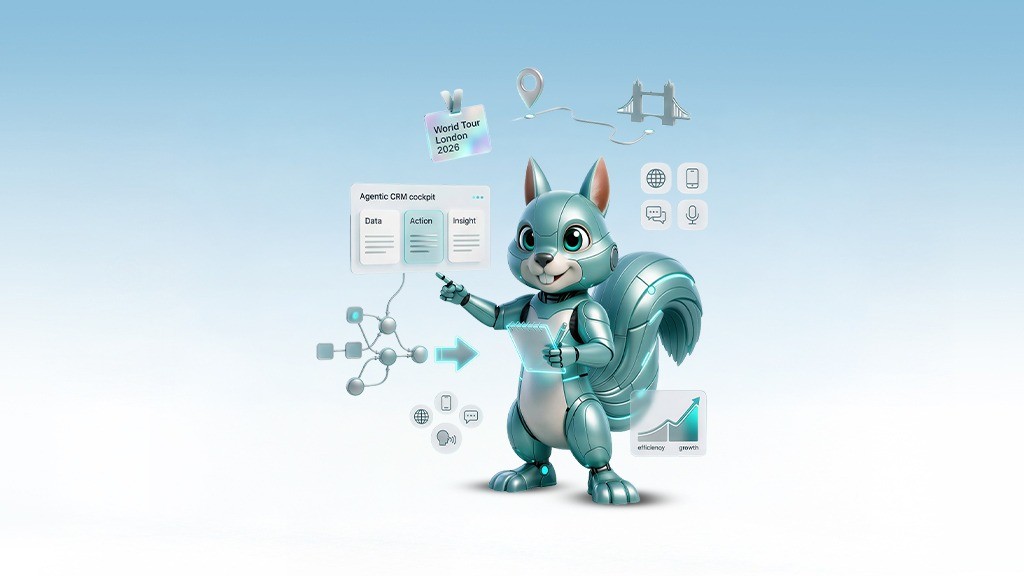
We took notes for you.
Salesforce’s biggest UK event of the year, Agentforce World Tour London 2026, was shaped this year around a single powerful idea: the Agentic Enterprise.
In other words, CRM moving beyond being merely a system of record and transforming into a structure that understands data, offers recommendations, and can take action in the right place.
When the doors opened at ExCeL London on 18 June, the atmosphere in the hall felt a little different. The “AI is coming, get ready” message we heard so often in previous years had now given way to a clearer question: AI is here. So how do we create value and growth with it now?
Salesforce UKI CEO Zahra Bahrololoumi delivered this message quite clearly in the opening. Agentic AI is no longer just a topic where we talk about efficiency, it’s a reality reshaping customer experience, operations, and growth models across every industry.
That’s exactly why it mattered that organisations like Thames Valley Police, Canada Goose, Adecco, and Formula 1 took the stage to tell their own transformation stories. Because this year, the conversation wasn’t about “this could work”, it was much more about “we did it, and it worked here.”
Between you and me, when real cases start getting as much airtime as demos at a tech event, it means things have genuinely moved from theory into practice.
First, the essence of it: where do AI agents fit within CRM?
Salesforce’s message this year was quite clear: AI agents are no longer helper tools sitting at the edge of CRM, they’re digital teammates positioned right at the centre of the work.
In sales, they can prioritise opportunities; in service, they can handle customer requests; in marketing, they can make segments and actions more meaningful. In other words, we’re talking about a structure that doesn’t just generate reports but actually moves the work forward.
Salesforce is testing this approach internally as well, through a “Customer Zero” perspective. Teams work alongside agents that write code, operate within support processes, and hand off context to a human when needed. The important detail here is this: the agent steps in, but the human doesn’t leave the game entirely. On the contrary, it allows people to devote their time to the right work.
Within the Agentic Enterprise framework presented by Salesforce EVP and Chief Digital Officer Joe Inzerillo, five core systems stand out:
- context,
- work,
- authority and action,
- engagement,
- insight.
It may sound a little abstract at first, but there’s a very concrete message underneath: for an AI agent to truly get work done, it needs quality data, clear processes, and strong governance behind it.
So the point isn’t just “let’s set up an agent.” The point is designing, from the very outset, which data that agent will trust, which actions it can take, where it will hand off to a human, and how its success will be measured.
And that’s exactly where the whole story of moving from pilot to real operation begins.
A new colleague for sales teams: Agentforce Coworker
One of the standout topics on the sales side was Agentforce Coworker. We can think of it as an agent that works within Slack, interprets business data, and helps sales teams see their priorities faster. It doesn’t just put a dashboard in front of you; it points out which opportunity you should focus on, who it’s critical to get in touch with, and what the next step might be.
In other words, we’re moving from the era of “let’s look at the report and interpret it” to the era of “let’s take the recommended action and move forward.”
And that’s a very critical threshold in CRM transformation. Because for sales teams, the real value isn’t data sitting somewhere, it’s that data turning into the right action at the right moment.
The star of the stage: Bobbi and Thames Valley Police
One of the most talked-about cases of the day was Bobbi, the UK’s first police AI agent.
Bobbi is an AI agent built on Agentforce for Thames Valley Police and Hampshire & Isle of Wight Constabulary. It’s positioned as an additional digital point of contact for citizens to reach the police.
The problem here is a very real one: heavy call traffic, waiting times, non-emergency requests, and the burden on operational teams.
It was shared that, over six months of use, Bobbi was able to handle a workload equivalent to roughly 14.000 citizen contacts on an annual basis, and gave teams back over 3.200 hours of operational time.
That figure matters. Because the success of an AI project isn’t measured solely by the question “how many people used it?” The real question is: how much time, access, and focus did it give back to people?
And that’s exactly what we see in Bobbi’s case. The agent takes on repetitive, routable requests, while police teams can devote their time to more critical matters.
A similar public-sector example comes up on the NHS Shared Business Services side. Agent Murphy handles finance and procurement queries in natural language, resolves many requests within 24 hours, and shortens the average processing time.
This shows that agentic AI isn’t just a topic for retail, e-commerce, or tech companies. There’s serious transformation potential in more complex processes too, public services, healthcare, security, finance, and operations.
Headless 360: the invisible architecture of customer experience
One of the topics we made a particular point of noting in London was Headless 360.
In its simplest form, we can think of it this way: a structure in which agents don’t have to stay inside the Salesforce screen and can instead operate across different applications, websites, mobile channels, Slack, WhatsApp, voice channels, or other systems.
In other words, the place where the experience happens is no longer a single screen. Wherever the customer is, the agent goes there too.
This is a significant turning point for the CRM world. Because customer experience is no longer built on “bringing the customer to the system”, it’s built on carrying the system to wherever the customer is.
When a customer is completing a transaction on your website, getting support in your mobile app, asking a question over WhatsApp, or waiting in a service channel, the agent can step in with the same data, the same context, and the same ability to take action.
Of course, the critical point here is the same as ever: for this structure to work properly, the data needs to be clean, accessible, and reliable. Otherwise, even the best-designed agent can end up limited by the wrong context.
The big picture: from efficiency to revenue
One of the clearest messages from Agentforce World Tour London 2026 was this: AI agents are no longer talked about merely as a cost-reduction tool.
In the first wave, companies were mostly asking questions like “how do we reduce repetitive work?”, “how do we ease the service load?”, “how do we save teams time?”
Now the question has shifted somewhat: How do we create a better customer experience with AI agents, how do we sell faster, how do we capture new revenue opportunities?
This transition is very important. Because the real competitive advantage of agentic AI lies not just in operating at a lower cost, but in making faster decisions, delivering a more personalised experience, and being able to take the right action at the right moment.
In short, the agenda is no longer just efficiency. The agenda is growth.
But let’s not forget: human readiness is just as critical as technology
One of the most realistic topics discussed at the event was the human side.
Because bringing AI agents into an organisation isn’t enough on its own. Teams need to be prepared for this new way of working, they need to know which work to leave to the agent, at which point to step in, and how to make decisions.
In many organisations today, technology investment runs ahead of the work; but training, adaptation, and governance lag behind.
That’s why agentic transformation isn’t a matter for IT or technology teams alone. It’s a transformation that sales, service, marketing, operations, human resources, and leadership teams all need to take ownership of together.
In other words, there’s no “we bought the tool, job done” era. In this transformation, the real difference lies in being able to embed the technology properly into the way the organisation works.
Why does the Fin acquisition matter?
Let’s also recall that, just a few days before the London agenda, Salesforce signed a definitive agreement to acquire Fin for approximately $3.6 billion.
Fin is a company that stands out for its AI agent technology in customer support processes. This move by Salesforce shows just how strategic the agentic service side, that is, AI-powered customer service, has become.
This acquisition can be read as a step that will strengthen Agentforce’s power, particularly in the area of service and customer experience.
In other words, Salesforce’s message doesn’t stay confined to the stage. Its product, investment, and acquisition strategy all point in the same direction: the future of CRM is being shaped by AI agents that can take action.
The Inspark perspective: from a record-keeping CRM to an action-taking CRM
The fundamental idea underlying everything discussed in London aligns perfectly with the approach we at Inspark have long championed:
The value of a CRM is measured not by how many records it holds, but by its power to turn that data into the right action at the right moment.
At Inspark, we approach Salesforce, Agentforce, Data Cloud, and AI-focused CRM solutions with exactly this perspective. We design customer experience not merely as a touchpoint, but as an end-to-end structure that works through the collaboration of data, process, channel, and people.
Because a good CRM project today is no longer just about designing screens, creating fields, or generating reports. It means bringing the right data together, increasing teams’ decision-making speed, reaching customers in a more personal and timely way, reducing repetitive workloads, and creating actions that touch the organisation’s real operations.
We saw this in Bobbi’s case too. The agent’s value emerges not in the number of conversations, but in the time it gives back to teams, the access it provides to citizens, and the way it helps operations run better.
The same logic applies to sales, service, marketing, and every area of customer experience.
- For a sales team, this might mean seeing more quickly which opportunity to prioritise.
- For a service team, it might mean resolving the customer’s problem at the very first contact.
- For a marketing team, it might mean bringing the right segment together with the right message at the right time.
- And for a leadership team, it might mean making decisions based on meaningful insight rather than scattered data.
The clearest lesson from London
In our view, the clearest lesson from Agentforce World Tour London 2026 is this: you’re only as good as the data behind your agent.
If your data strategy isn’t ready, if your processes aren’t clear, if you have no governance model, even the most impressive AI agent can get stuck at the pilot stage.
But when the right data, the right processes, and the right human-agent collaboration come together, CRM stops being a passive record-keeping system. It transforms into a growth platform that takes action, from sales to service, from marketing to operations.
In short, the question is no longer “should we use AI?”
The question is: how do we get our data, our processes, and our teams ready to work with AI agents?
At Inspark, this is exactly the question we’re building the answer to.
Agentic transformation may sound like a big undertaking, but the starting point is usually very clear: data, process, and the right use case. To talk through where to begin, we can set up a coffee with Inspark’s experienced Salesforce and CRM specialists.