For the past year, the same question keeps circulating everywhere: “Will AI agents take our jobs away?”
Honestly, this question misses the most interesting part of the debate.
Because the real issue isn’t what agents will do, but what humans will keep doing.
From Routine Work to a Strategic Role
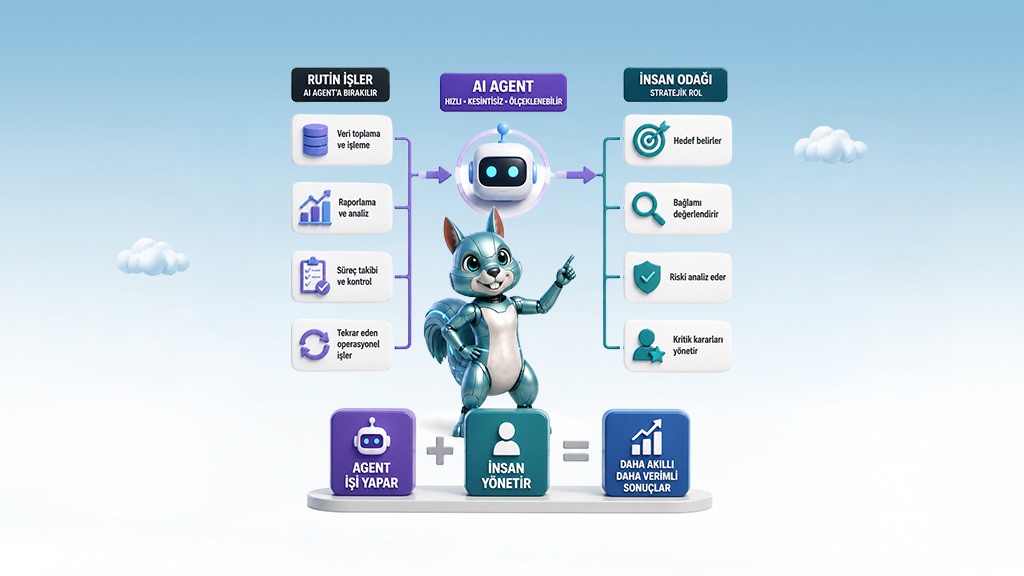
AI agents are rapidly taking over tasks like data collection, reporting, process tracking, and repetitive operational work. That’s a fact. But it doesn’t mean humans are being sidelined. On the contrary, it shows us that the human focus is shifting.
As Salesforce’s piece on Agentic AI’s impact on the workforce also emphasizes, as agents take on routine tasks, the employee’s role doesn’t disappear, it evolves from ”executor” toward someone who “manages, develops strategy, and makes decisions.”
So the question is no longer ”who will work?” but “who will focus on what?”
The Agent Is Not Your Coworker, It’s an Instrument
Here, IDC’s approach frames things much more clearly. In “The Future of Work: AI Agents as Instruments, Not Co-workers,” IDC positions agents not as “digital colleagues” replacing humans, but as powerful tools that amplify human capacity.
This distinction is critical. Because how well an instrument is used ultimately depends on the skill of the person wielding it. Yes, the agent does the work, fast, uninterrupted, and at scale. But it’s still the human who sets the goal, reads the context, assesses the risk, and makes the critical decision.
________
Agents do the work. Humans set the goals, evaluate context, and manage the critical decisions.
________
Human-AI Collaboration: The Work Model of the Future
What we’re really talking about today is a new organizational model, one where humans and agents work together with clearly divided responsibilities.
Some of the key shifts that stand out in this model:
- Decision points stay with humans: Agents analyze, recommend, and even take some actions automatically. But decisions carrying strategic or ethical weight still have to go through human approval.
- New roles: Titles like AI agent management, AI operations, and AI governance are now appearing in company org charts, because someone needs to oversee what agents are doing, how they’re deciding, and where they need to stop.
- Creativity and problem-solving move to the forefront: As routine tasks get delegated to agents, people’s time shifts toward strategic and creative work that used to get postponed for lack of time. It’s worth noting that while agents rely on historical data and defined rules, producing creative solutions in new and unpredictable situations remains a distinctly human competency.
Why Should Organizations Redesign Their Processes?
This is exactly where most companies miss the point: having powerful AI technology is only half the transformation.
The other half is deciding what process, what division of responsibility, and what governance structure you’ll run that technology with.
Deploying an agent is easy. But if it’s unclear which data it can access, which decisions it can make automatically, at what point it hands off to a human, and how its performance will be monitored, what results isn’t efficiency, it’s a lack of control.
That’s why agentic transformation shouldn’t be treated as just a technology project, but as a project of process design, role definition, and governance.
So Where Exactly Does Human Value Get Created?
While agents bring speed, scale, and consistency to the work, humans bring meaning, context, and direction.
An agent can tell you “churn rate went up 12% this month.” But interpreting why it went up, deciding which action is right for which segment, and evaluating how that fits the company’s overall strategy, those are still human work.
This is exactly where human value takes shape: in strategic thinking, creativity, empathy, and the ability to ask the right question. In the age of agents, the most valuable skill is no longer “working faster”, it’s “getting the agent to do the right work in the right way.”
The Inspark Perspective
As Inspark, we’ve long managed CRM, data, and automation processes from this perspective: technology exists not to replace people, but to free them up for more strategic work. We follow the same principle as we integrate agent technologies into customer experience, sales, and marketing processes. In the end, while agents take on routine and repetitive tasks, the critical decision points, the strategic management of customer relationships, and the voice of the brand remain firmly within human competence.
If you’re thinking about how to position AI agents in your company with the right processes and governance structures, you can get in touch with Inspark’s expert teams.
Sources:
Salesforce, “Agentic AI’s Impact on the Workforce: How Agentic Technology Is Reshaping Work”
https://www.salesforce.com/news/stories/agentic-ai-impact-on-workforce/
IDC, “The Future of Work: AI Agents as Instruments, Not Co-workers” https://www.idc.com/resource-center/blog/the-future-of-work-ai-agents-as-instruments-no-co-workers/