If you asked what the first moment a customer meets your brand is, most of us would still picture the same scene: they type something into Google, look at the results, click on your site, browse the product page, and then either buy or walk away.
Search → Website → Product Page → Conversion.
This is the flow we’ve built strategies around, reported on, and optimized for years. The problem is, this flow no longer fully reflects reality.
Salesforce’s new State of Commerce report confirms with numbers something most of us have already sensed intuitively: customers are now starting their purchase journey outside the brand’s own platforms, without the brand even knowing. Agentic search means a customer starting their journey by asking an AI assistant like ChatGPT, Gemini, or Copilot directly, “find me a waterproof hiking boot under $150.” According to the State of Commerce report, this behavior has grown 200% year over year. Looking at the behavior of the 1.5 billion global shoppers measured in the same report, traffic from AI chat platforms to commerce sites grew between 150% and 428% each quarter, while sites’ overall traffic stayed in the single digits or low double digits. The gap is too large to ignore.
Even more striking is that this shift isn’t just behavioral, it’s perceptual too. 86% of commerce leaders believe LLMs will play a critical role in product discovery within the next year. This is no longer a “future scenario”, it’s a forecast with near-consensus behind it.
Discovery is slipping out of the brand’s control
The real breaking point here is this: the customer’s first contact with the brand is no longer happening on a channel the brand designs, measures, and optimizes. While chatting with an AI assistant, they compare products, weigh price-to-performance, and make a significant part of their decision without ever visiting your site. By the time they arrive at the site, they already have a preconceived opinion.
This flips a familiar funnel for marketing and commerce teams. Alongside “how do I drive traffic to the site,” a new question is now on the table: ”how do I exist as one of the brands AI talks about, recommends, and compares.” According to Salesforce’s data, companies aren’t standing still in the face of this shift: improving product content quality, optimizing content for conversational-style queries, and feeding data to AI search platforms are among the most common steps being taken. But most of these efforts are still concentrated at the discovery stage. In short, the fully autonomous purchase experience is still maturing.
The less-discussed but critical piece on the CRM side: context
There’s a dimension of this that gets talked about less than the marketing side, but is just as critical: when a customer makes first contact with a brand now, the brand knows nothing about that contact. As the starting point of the journey moves outside the channels the brand controls, “getting to know” that customer again, greeting them with the right context, and connecting them to previous interactions becomes a much harder problem.
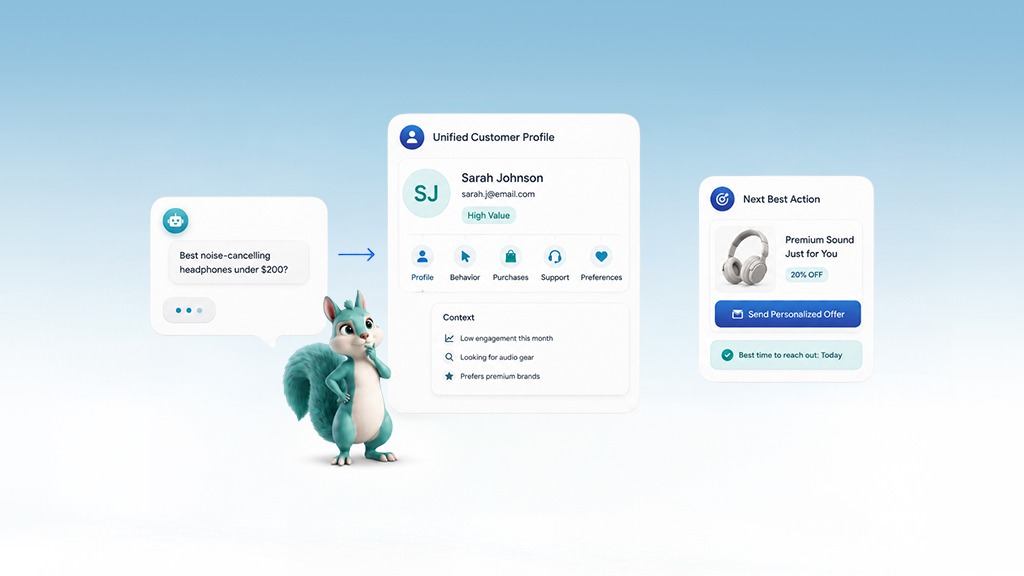
This brings us straight to CRM and data architecture. First-party data, a unified customer profile, cross-channel attribution, and data integrity are no longer “nice to have”, they’re the precondition for the customer journey staying coherent instead of fragmenting. One finding in Salesforce’s report captures this exactly: only 27% of companies say their customer data is genuinely unified across sales, service, marketing, and commerce. When data is fragmented, it becomes impossible to greet the customer AI recommends or routes to your site with the right context. And this fragmentation isn’t an abstract cost either, it shows up as slow customer service, immeasurable investment impact, and unnecessary system complexity.
In other words, AI-driven discovery doesn’t diminish the importance of CRM strategy, it actually makes it more visible. As discovery channels diversify, a brand’s ability to quickly and accurately answer “where do we know this customer from, what do we know, in what context are we greeting them” becomes the competitive advantage itself.
A similar shift in control is happening in advertising
This shift isn’t limited to discovery and content, it’s moving in the same direction on the media buying side too. According to Gartner’s forecast published on August 6, by 2028 more than 70% of global ad spend, and more than 80% in the US, will flow through self-service platforms where AI directly influences media buying, pricing, and outcomes. This isn’t about generative AI creating ad creative, it’s about another AI layer working behind the scenes, deciding which ad gets shown to whom, when, and at what cost.
Gartner’s forecast comes with a warning attached: platforms becoming more efficient doesn’t automatically mean lower costs for advertisers. In other words, as brands hand over more and more decisions to platforms, they still need to maintain the capacity to independently measure the outcomes of those decisions. Otherwise, platform dependency grows, the brand’s control over its own customer data weakens, and the answer to “is this actually working” ends up resting on the platform’s own reporting.
The common thread: not a fragmented experience, but a unified journey
AI-driven search on the discovery side and AI-driven media buying on the advertising side may look like two separate developments, but they’re really two faces of the same story. The customer journey is moving outside the channels the brand can directly see and manage, and part of the decision-making process is now taking shape in layers the brand can’t reach.
At this point, the question facing brands isn’t “which channel should we allocate more budget to” anymore, it’s “how do we strengthen the data, context, and measurement we still have as our control shrinks.” Treating CRM, marketing, and commerce strategy as three separate, independent disciplines is becoming an increasingly costly choice on this new journey. Because even if the customer starts discovery in an AI assistant, they don’t experience these three separately, they experience it as a single brand experience.
The Inspark perspective
AS Inspark, we approach the customer journey with exactly this holistic view: we build CRM, data, and customer experience not as disconnected projects, but as parts of a single architecture. Regardless of where the journey begins, a brand’s ability to greet the customer with the right context at the right moment is one of today’s most concrete competitive advantages.
If you’d like to discuss what this transformation means for your company, we’d be glad to talk.